
The Case for the First Flight Out
The alarm hurts. Everything after it gets easier. A data-informed argument for booking the departure nobody wants.
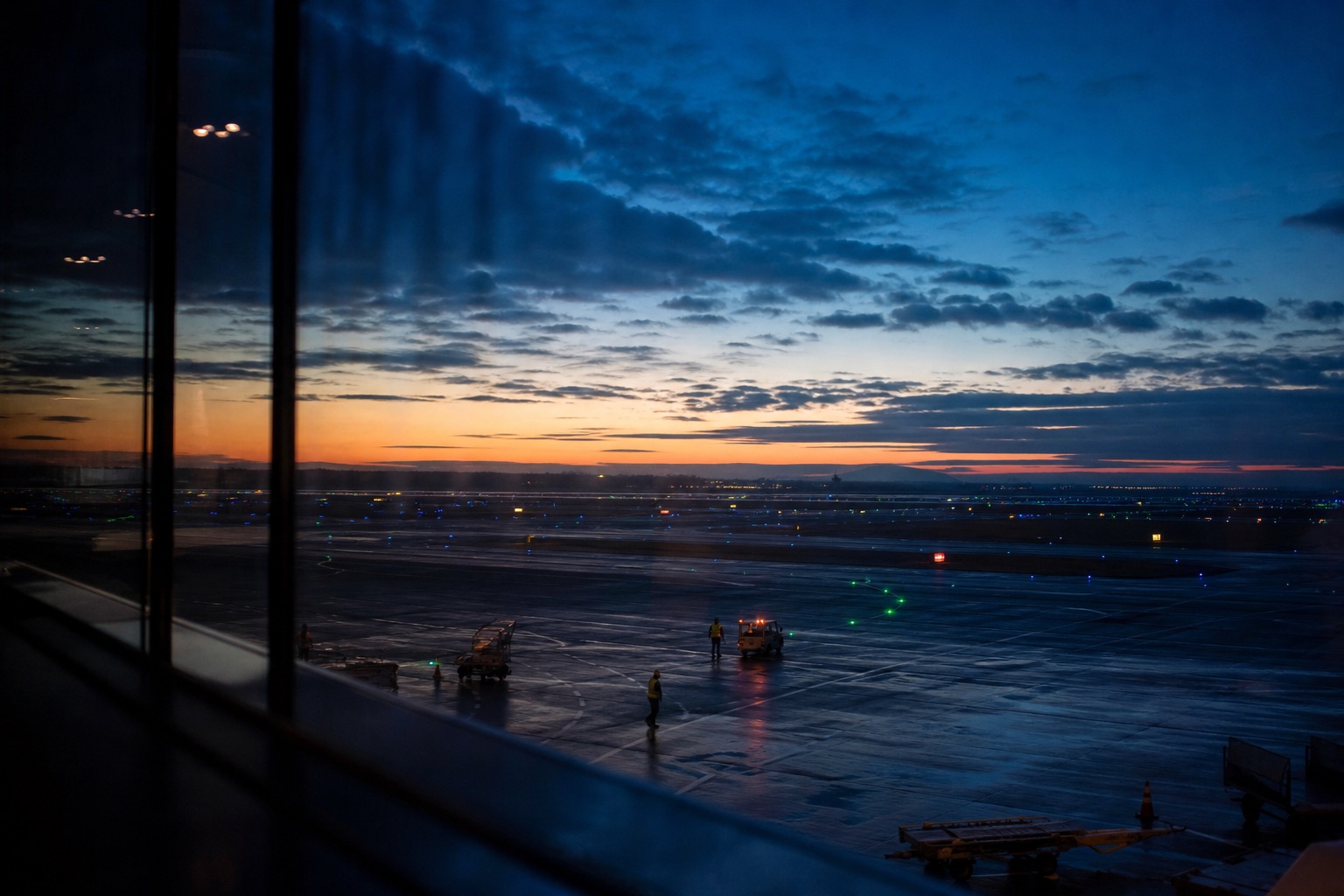
Nobody brags about a 6 a.m. departure. It is the flight of grim faces at the gate, of taxis ordered while the street lights are still on, of breakfast eaten standing up in a kitchen that feels like the middle of the night because it is. And yet, year after year, it remains the smartest booking on the schedule — not as a matter of taste, but as a matter of how the aviation day is built.
The cascade: why afternoons inherit trouble
To understand why early flights behave better, picture the system rather than the flight. A short-haul aircraft might fly five or six segments in a day: out and back, out and back, out again. The crew flying your 4 p.m. departure has likely been working since morning, on an aircraft that has already visited two or three other cities.
Every segment is a chance for the day to slip. A slow boarding here, a ground stop there, a thunderstorm parked over a hub at 1 p.m. — none of it needs to be dramatic to matter. Delays in a networked system do not stay where they start; they cascade. The 4 p.m. flight is not late because of anything happening at 4 p.m. It is late because of something that happened at 11 a.m., two cities away.
Federal on-time statistics have shown this pattern for as long as they have been collected: departure punctuality is strongest in the first hours of the operating day and erodes as afternoon builds, with the worst reliability typically landing in the late-afternoon and evening banks. The first flight of the morning is flown by an aircraft that arrived the night before and a crew that started fresh. There is nothing upstream to inherit. The day has not had time to go wrong yet.
Weather keeps morning hours too
The cascade is only half the argument. The other half is meteorological, and it is most vivid in summer.
Convective weather — the towering afternoon thunderstorm that closes departure corridors — is largely a creature of daytime heating. The atmosphere needs hours of sun to build those storms, which is why they cluster from mid-afternoon into evening across most of the continental interior. A 7 a.m. departure usually operates in the calmest air of the day. A 5 p.m. departure in July is negotiating with the sky.
Morning is not weatherproof — fog is a dawn phenomenon, and winter storms do not check the clock — but across a year of bookings, the early departure simply encounters fewer of the events that stack airplanes into holding patterns.
The quieter, human advantages
The statistics get the argument started; the texture of the early airport finishes it.
- Security at 5:15 a.m. is a different experience. Checkpoint staffing is tuned to the morning rush, but the rush itself builds in waves — arrive ahead of the first wave and the airport is nearly frictionless.
- A morning delay has somewhere to go. If the first flight does slip, every subsequent departure that day is a rebooking option. Miss the last flight of the evening and your options are a hotel voucher and a philosophical attitude.
- You land with the day intact. An early departure turns travel day into travel morning. Arriving at noon instead of 9 p.m. means the first day of the trip is a day, not a check-in and a collapse.
- The empty terminal is genuinely pleasant. This is subjective, but the pre-dawn airport — half-lit, quiet, the floor polishers still working — has an atmosphere the 6 p.m. version cannot offer. It feels less like being processed and more like being early to something.
The honest costs
An argument that hides its costs is an advertisement, so here are the real ones.
The alarm is brutal, and pretending otherwise convinces no one. A 6 a.m. departure means waking around 4, and for travelers who fall asleep late, that can mean starting a trip on five hours of sleep — a real tax on the first day, and roughly the same fatigue you were trying to avoid by not arriving late.
Ground transport is the second cost. Public transit in most cities does not run meaningfully before 5 a.m., which pushes early flyers toward ride services at pre-dawn pricing or a car left in long-term parking. Budget for it; the "cheap early flight" is less cheap after a $50 ride to the terminal.
And there is a social cost. The night before an early flight is not really yours — dinner ends early, the bag must be finished, and the evening acquires a curfew. For a weekend trip, that borrowed evening matters.
Making the early departure survivable
The trick is to move every decision out of the morning. The morning of an early flight should contain zero choices — only execution.
- Pack completely the night before, including the toiletries you will use that morning (decant what you need into the bag as the last act before bed).
- Lay out clothes down to the socks. Dressing in the dark should require no thought.
- Book the ride before sleeping, with a scheduled pickup, and set two alarms on two devices.
- Prepare a grab-and-go breakfast — something that survives a counter overnight. Eating before security beats gambling on what is open at 5 a.m.
- Check in and load the boarding pass the night before, and screenshot it. Airport Wi-Fi and phone signal at dawn are not the moment to rediscover your password.
Done this way, the early morning stops being an ordeal and becomes a procedure: wake, dress, lift bag, leave. The suffering is concentrated into a single unpleasant minute — the alarm — and everything after it runs downhill.
The booking rule I actually use
When schedules allow, I book within the first two departure banks of the day, and I treat anything after 3 p.m. as a flight that needs a reason to exist — a fare gap too large to ignore, a connection that demands it, an event the night before. Not because afternoon flights are doomed, but because when I am choosing freely, I would rather borrow trouble from my alarm clock than from the entire aviation system's afternoon.
The first flight out is the closest thing scheduled air travel offers to a controllable variable. You cannot move the weather, staff the checkpoint, or un-delay the inbound aircraft. You can set an alarm. Of all the trades travel asks you to make, an hour of sleep for a day that runs on rails is consistently the best one on offer.
Source notes
Facts in this story were checked against the following public resources at the time of writing:
- U.S. Bureau of Transportation Statistics, "On-Time Performance"
- Federal Aviation Administration, "Air Traffic By The Numbers"
- U.S. Department of Transportation, Air Travel Consumer Report
- National Weather Service, aviation weather resources

Samantha “Sam” Hollis
Sam is the writer and publisher of this journal. She covers the practical craft of travel — the departures, connections, and systems — from her desk in Madison, Wisconsin. More on the about page; corrections welcome via the contact page.