
Packing as a System
Packing is not a chore to survive before each trip. It is a system to build once — and then merely run. The full architecture, from the 1-2-3 ratio to the never-unpacked core.
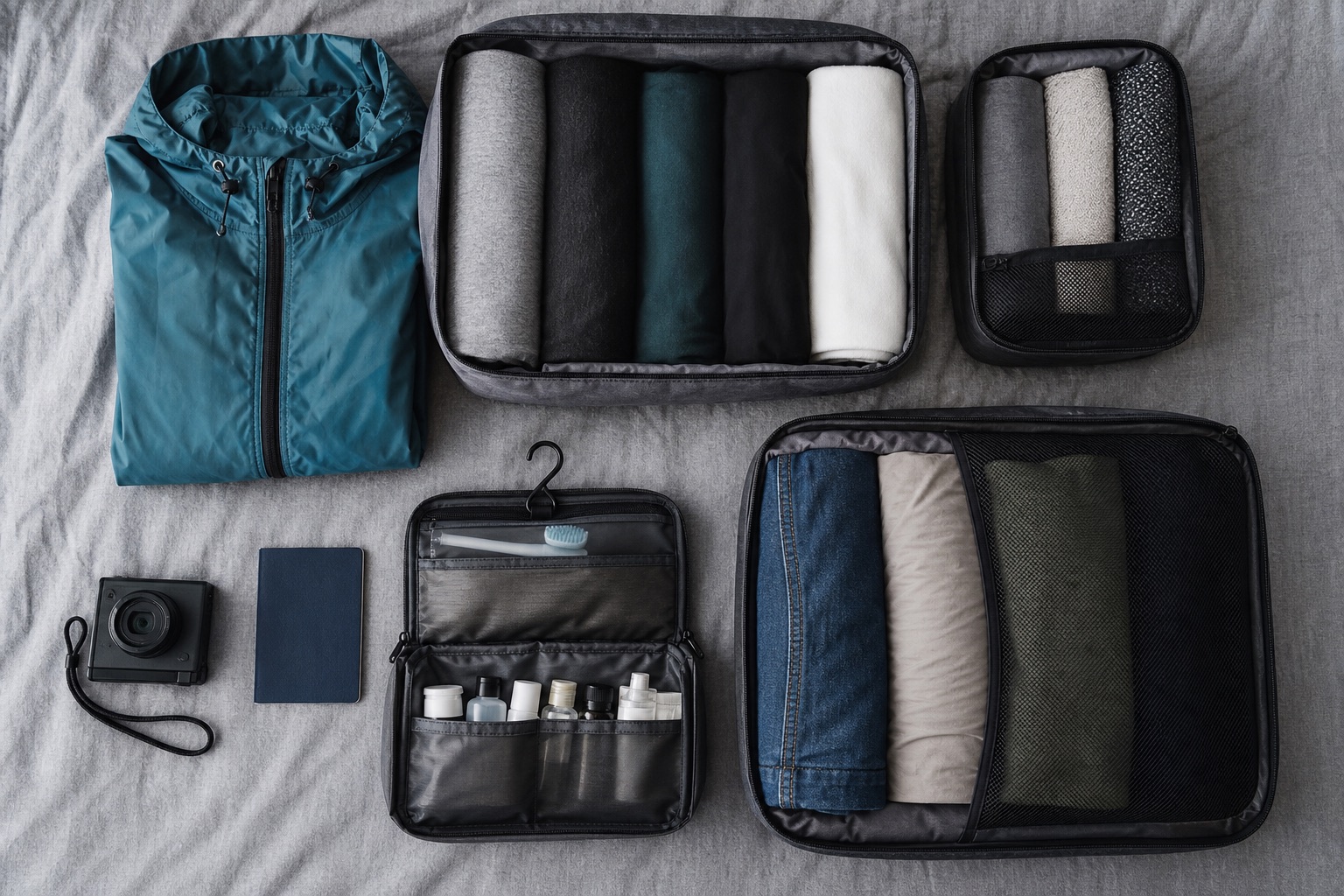
For years I packed the way most people pack: the night before, in a mild panic, by walking laps between closet and suitcase while reciting the trip to myself like a spell. The result was always the same — too many tops, not enough socks, a charger forgotten, and a bag that contained three hypothetical versions of the trip instead of the actual one.
The fix was not a better suitcase or a stricter attitude. It was realizing that packing is a systems problem, and systems problems are solved once, not every Thursday night. What follows is the full architecture I run now. Building it took one afternoon. Running it takes fifteen minutes per trip.
The insight: separate deciding from doing
Watch someone pack badly and you will see the real problem: they are making dozens of decisions and executing them at the same time. What if it rains? Do I need the nicer shoes? Where is the adapter? Every object triggers a fresh deliberation, and deliberation under time pressure defaults to "throw it in."
A packing system pre-makes the decisions. What goes in the bag becomes a lookup, not a debate — and the packing itself becomes assembly, which is fast, calm, and hard to get wrong.
Layer one: the standing kit
The foundation is a core kit that never gets unpacked. Mine lives in one small cube and one toiletry pouch, and it contains everything that is identical on every trip:
- Toiletries in travel sizes: toothbrush, paste, floss, razor, deodorant, sunscreen, and a small bottle set for whatever else — all within carry-on liquid limits, all decanted. Full-size bottles never travel; they are weight and risk with no upside.
- A charging set: one multi-port wall charger, two cables, a power bank, and a universal plug adapter. Bought as duplicates so the home set never has to be raided.
- The small salvation items: earplugs, an eye mask, a folding tote, basic medications, a few adhesive bandages, a pen (customs forms still exist), and two spare zip bags.
When a trip ends, the kit gets restocked immediately — the depleted sunscreen refilled, the power bank recharged — and returned to the shelf sealed. This is the single highest-leverage habit in the whole system: restocking at trip-end, when the gaps are obvious, instead of at trip-start, when they are invisible.
Layer two: the ratio
Clothing is where packing anxiety lives, and ratios kill it. After enough trips, I stopped asking "what will I need" and started asking "how many days" — because for a given climate, the answer to the first question is a function of the second.
The ratio I run for temperate travel:
- Bottoms: one per three days, minimum two.
- Tops: one per two days, plus one.
- Socks and underwear: one per day, capped at seven — past a week, you are doing laundry anyway, and accepting that fact is the difference between a carry-on and a checked bag.
- Layers: exactly one warm layer and one rain layer, regardless of forecast. Forecasts are guesses; layers are insurance.
- Shoes: the pair on your feet plus at most one more. Shoes are the least dense, heaviest thing in any bag, and the third pair is almost never worn.
Every item must work with at least two others. The shirt that matches only one pair of pants is not an outfit; it is a dependency, and dependencies are how bags bloat.
The point of the ratio is not fashion minimalism. It is that a ten-day trip stops being a packing problem and becomes multiplication. Four bottoms, six tops, seven of the daily items, two layers. Done. No laps around the closet.
Layer three: cubes as spatial memory
Packing cubes get sold as compression tools, and they do compress — but their real function is spatial memory. Each cube is a category with an address: one for tops, one for bottoms, one for the daily items, the standing kit in its own. The bag becomes a chest of drawers rather than a stew.
The payoff compounds mid-trip. Living out of a bag for a week usually degrades into archaeology by day three. With cubes, the bag stays navigable to the end — and hotel-room departure sweeps get faster, because everything has exactly one place it could be.
Two techniques worth adopting inside the cubes. Roll, don't fold, for everything that does not wrinkle catastrophically; rolls pack denser and reveal the whole cube's contents at a glance. And pack one cube empty-ish — the laundry cube, which starts nearly flat and fills as the trip runs. Dirty clothes with their own address means the clean cubes stay clean, and the homecoming unpack takes four minutes: laundry cube to the machine, standing kit to the shelf, done.
The stairs test
Every packed bag takes one exam before it leaves the house: carry it up a flight of stairs. Not roll — carry. If the answer at the top is a grimace, the bag fails, and something comes out.
The test works because it simulates the worst five minutes of the actual trip — the metro station without an escalator, the walk-up rental, the cobblestone kilometer — at a moment when fixing the problem costs nothing. A bag that passes the stairs test is a bag you never think about again for the whole journey, and not thinking about the bag is the entire goal.
What the system gives back
The obvious return is time: fifteen-minute packing, four-minute unpacking, zero pre-trip dread. But the compounding return is what the system does to travel itself. A spontaneous weekend becomes genuinely bookable, because departure prep is trivial. The first hours of every trip improve, because nothing critical was forgotten — the system, not memory, guarantees it. And the bag stops being a source of low-grade background worry, which frees attention for the actual point of going anywhere.
Packing well is not a virtue and packing badly is not a character flaw. It is just a process that most people re-improvise every single time, at the worst possible hour, under the worst possible pressure. Build it once instead. The suitcase was never the problem; the Thursday-night decisions were.
Source notes
Facts in this story were checked against the following public resources at the time of writing:
- U.S. Transportation Security Administration, liquids rule
- U.S. Department of Transportation, baggage guidance for air travelers
- International Air Transport Association, baggage standards overview
- American Academy of Dermatology, sun protection basics

Samantha “Sam” Hollis
Sam is the writer and publisher of this journal. She covers the practical craft of travel — the departures, connections, and systems — from her desk in Madison, Wisconsin. More on the about page; corrections welcome via the contact page.