
Arriving After Dark
Late landings are sometimes the only landings on offer. How to script the airport-to-bed sequence so an unfamiliar city at midnight is a procedure, not an adventure.
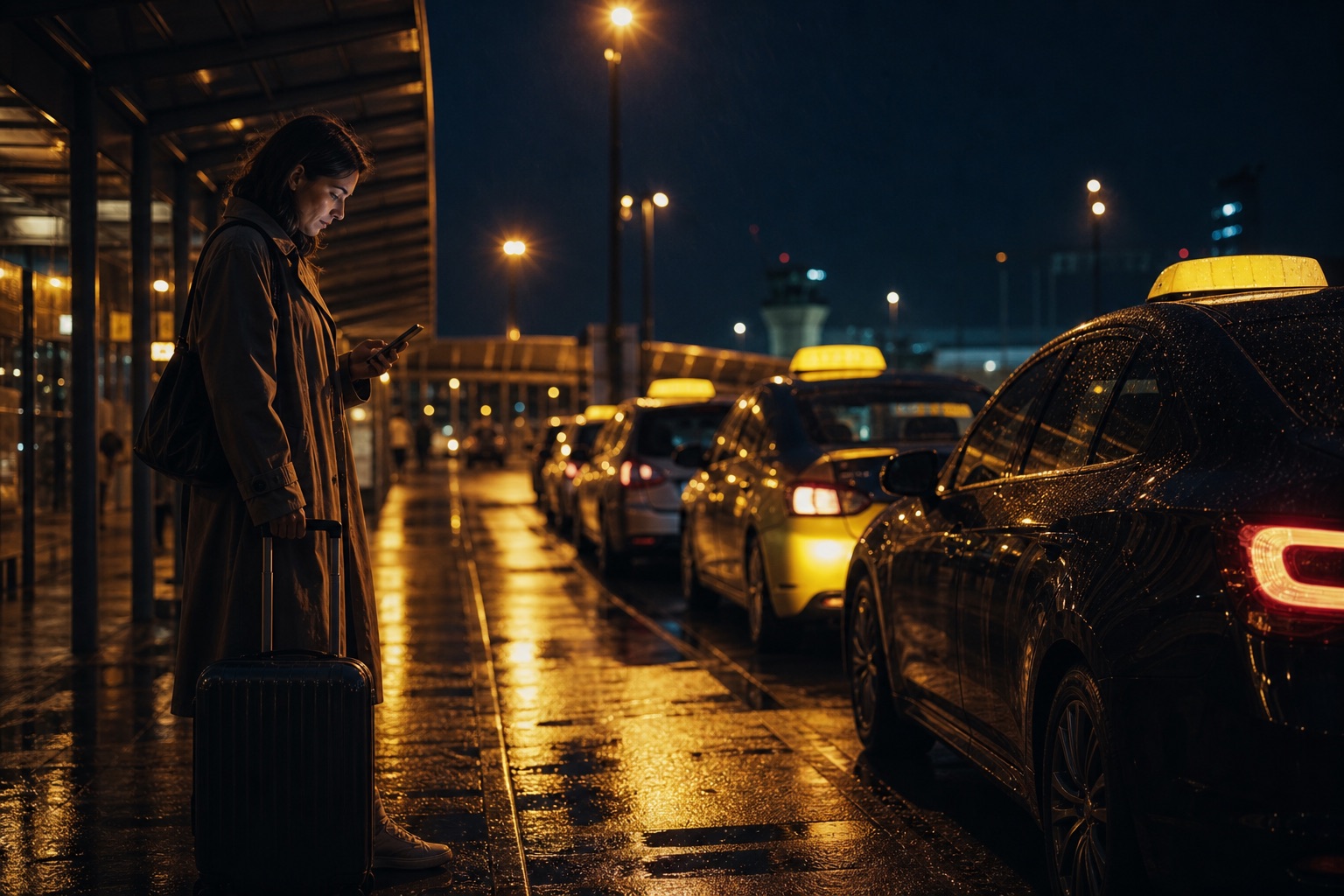
The cheapest fare on the board is often the one that lands at 11:40 p.m., and sometimes it is not about money at all: schedules, connections, and the shape of a weekend conspire, and the only sensible flight arrives after dark. So there you are — an unfamiliar airport at midnight, a phone at 19 percent, and a city between you and a bed you have never seen.
I travel alone most of the time, and I stopped fearing the late arrival years ago — not because it stopped having risks, but because I stopped improvising it. Everything difficult about landing at night is difficult only when decided at night. Decided in advance, from a couch, with full battery and no fatigue, the same sequence is close to trivial. The protocol below is the couch version.
Why night arrivals go wrong
Name the actual failure modes and they turn out to be few and specific. Ground transport becomes a negotiation instead of a purchase — the licensed options thin out, the unlicensed options present themselves, and a tired traveler with no plan is exactly the customer they wait for. The lodging handoff fails — the "reception until 11 p.m." detail nobody read, the entry code that was never sent, the apartment host asleep. Navigation degrades — the phone dies, the airport Wi-Fi wants a local number, the address is in a script the taxi driver reads differently. And judgment degrades with it, because it is hour nineteen of a travel day and everything is closed.
None of these is exotic. All of them are pre-solvable. That is the entire thesis: a night arrival is a scripting problem.
The transport decision, made at booking
The moment a late-landing flight enters the cart, the first question is not the hotel — it is the ride. The order of preference I use, checked for the specific airport and hour:
- A prepaid, licensed transfer booked through the lodging or a reputable service, with the driver matched to the flight number. Costs more; buys a name on a sign and zero decisions at midnight. For a first visit to a country, this is the default.
- An official airport taxi rank or licensed ride-hail, verified in advance to operate at that hour at that terminal — and verified as to where exactly the pickup point is, because "outside arrivals" at some airports means a specific numbered door on a specific level.
- Rail or bus only if it genuinely runs late and delivers close to the lodging. Night transit that requires a transfer, or a fifteen-minute walk through an unfamiliar district at 1 a.m. with luggage, disqualifies itself. The daytime version of you would enjoy that walk; the arrival version should not be asked to do it.
Whatever the choice, the fallback is chosen too: if the train has stopped or the driver is a no-show, what is plan B, and what does it cost? Writing two lines of fallback into the trip notes takes a minute and converts a potential midnight crisis into a shrug.
The lodging handshake
The second pre-flight task is confirming that a human or a mechanism will actually let you in. The specific checks:
- Reception hours, read from the listing and then confirmed by message: "Arriving on the flight landing 23:40 — will check-in be possible around 00:45?" The written reply matters more than the listing.
- For apartments and self-check-in, the code or lockbox instructions requested and received before departure, screenshotted, and tested against the listing photos — which door, which courtyard, which floor. Apartment entrances that are obvious at 3 p.m. are riddles at 1 a.m.
- The address saved offline, in the local language and script as well as your own, ready to show a driver rather than pronounce.
The pattern across all of it: every handoff that depends on connectivity, battery, or another person's wakefulness gets a redundant offline copy. Screenshots, not links. Paper for the truly critical line — the address — because paper does not run out of battery at hour nineteen.
The kit adjustments
A late arrival changes what belongs in reach during the flight. The power bank rides in the seat pocket, not the overhead — landing with a dead phone is the single most common way the whole script fails. A small amount of local cash, obtained before the trip or at the origin airport, covers the scenarios where cards and apps do not: the night bus, the taxi that "can't take cards tonight," the vending machine. And the first-night essentials — toothbrush, medications, one change of underwear — travel on your body in the daypack, so that even a checked bag gone astray delays nothing until morning.
One more airborne task: fill in the arrival forms and download the destination's offline map before descent, while the seatback still counts down the minutes. The plan is to walk off the aircraft with nothing left to figure out.
The first ninety minutes, scripted
Landed, the sequence runs itself precisely because it was written earlier. Phone off airplane mode, confirmation screenshots open. Bathroom and water before leaving the secure area — small, and disproportionately restorative at hour nineteen. Straight to the pre-decided pickup point, no pausing to re-litigate the transport decision in front of the arrivals-hall hustlers, whose entire business model is travelers re-litigating decisions. Address shown, not spoken. On arrival at the lodging: door, code, bed. The city can introduce itself tomorrow.
And the protocol's final rule governs the next morning: nothing on the calendar before ten. The night arrival borrows its comfort from the following day, and the loan has to be honored — a slow breakfast, a late start, and the trip begins properly at the hour the body agrees to begin it. Travelers who land at midnight and book a 8:30 a.m. walking tour have simply moved the crisis, not avoided it.
The quiet payoff
Somewhere along the way, the scripted night arrival stopped being a defensive measure and became something I almost enjoy. There is a particular satisfaction in gliding through a sequence that would otherwise be stressful — the ride that is waiting because you arranged it, the code that works because you confirmed it, the bed reached forty minutes after the jet bridge because every decision was already made. The midnight city out the taxi window, all signage and rain-light, is genuinely beautiful when it is scenery rather than a problem.
Solo travel gets sold as spontaneity, and much of it should be. The arrival is the exception. Script the landing, and you buy the freedom to improvise everything that matters more.
Source notes
Facts in this story were checked against the following public resources at the time of writing:
- U.S. Department of State, traveler safety guidance
- U.S. Department of Transportation, Fly Rights
- Overseas Security Advisory Council, country transport reports
- Centers for Disease Control and Prevention, travelers' health

Samantha “Sam” Hollis
Sam is the writer and publisher of this journal. She covers the practical craft of travel — the departures, connections, and systems — from her desk in Madison, Wisconsin. More on the about page; corrections welcome via the contact page.